
AI can now write blog posts, generate advertising creatives, analyze campaign data, and automate tasks that digital marketers once spent hours completing.
Google Ads uses AI to optimize bidding and targeting. ChatGPT can help develop content strategies. Claude can analyze large datasets and automate parts of technical SEO workflows.
And these tools are getting more capable.
If you’re working in digital marketing, or planning to build a career in it, there’s a legitimate question worth asking:
Will companies still need digital marketers when AI can do so much of their work?
The short answer is yes, but not necessarily in the same numbers, roles, or working patterns as before.
AI is already reducing the manual effort required for many marketing activities. Some execution-heavy positions are becoming more vulnerable, while skills involving strategy, analysis, creativity, and business judgment remain important.
A 2026 study by the American Marketing Association found that execution-focused marketing roles were declining while senior and strategic positions were holding steadier.
That doesn’t mean everyone needs to become a marketing strategist overnight. It means the abilities that make someone valuable are changing.
Let’s examine what the research says, which digital marketing jobs face the greatest disruption, and what you can do to stay relevant.
What does the research say about AI replacing jobs?
These are four findings worth paying attention to.
| Research | Key finding |
| International Labour Organization, 2025 | About 25% of global employment has some exposure to generative AI |
| World Economic Forum, 2025 | 170 million jobs projected to be created and 92 million displaced globally by 2030 |
| American Marketing Association, 2026 | Marketing jobs were down 27% from pre-pandemic levels in its analysis |
| Anthropic Economic Index, January 2026 | 52% of sampled Claude.ai conversations involved augmentation, compared with 45% classified as automation |
1. The ILO expects more job transformation than complete replacement
In May 2025, the International Labour Organization published an updated assessment of generative AI’s potential impact on employment.
It found that approximately one in four workers globally were in occupations with some exposure to generative AI.
However, only 3.3% of global employment fell into its highest exposure category.
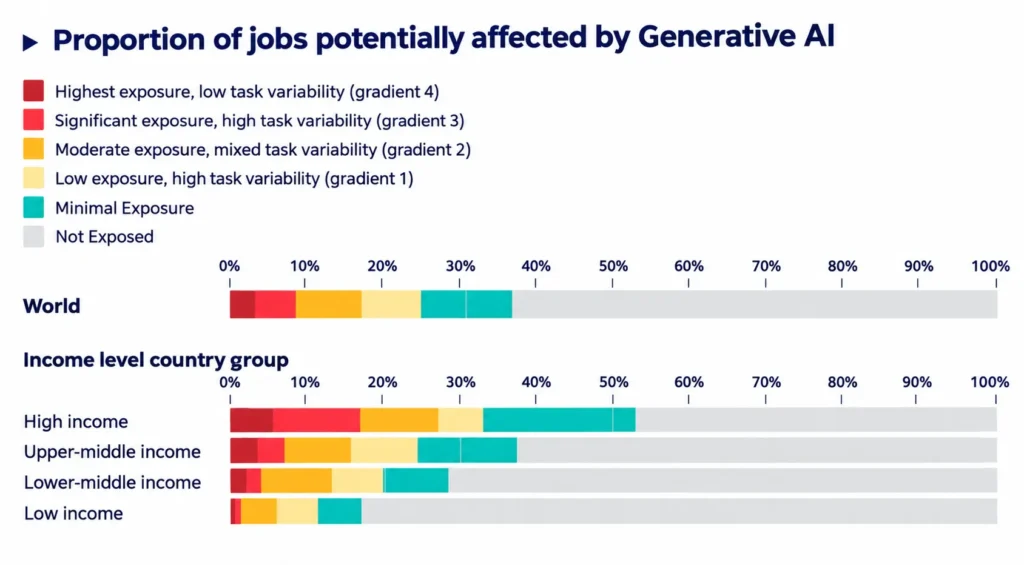
More importantly, the researchers concluded that job transformation was the more likely outcome for most occupations because many jobs still require human input.
Here’s why this distinction matters.
Imagine a digital marketing executive whose responsibilities include keyword research, writing content briefs, generating reports, and communicating with clients.
AI may automate parts of the first three activities.
But that doesn’t automatically mean the entire role disappears.
The person may spend less time preparing reports and more time analyzing performance or working with clients.
Of course, there’s another possibility: a company may decide it needs fewer employees to produce the same amount of work.
Both outcomes are possible.
The research tells us which work is exposed to automation, not exactly how employers will respond.
2. Marketing hiring is already changing
The American Marketing Association’s 2026 State of Marketing Careers Report provides more directly relevant evidence.
The research included a survey of 1,412 marketing professionals, job-posting analysis, and interviews with industry leaders.
It found that:
- Marketing jobs in its analysis were 27% below pre-pandemic levels.
- Execution-focused marketing roles were declining.
- Senior and strategic positions were holding steadier.
- The share of marketing job postings mentioning AI doubled during 2025.
- AI fluency was becoming a baseline expectation rather than a rare skill.
These findings deserve attention.
They don’t prove that AI caused the entire decline in marketing employment. Hiring is affected by economic conditions, business budgets, organizational changes, and other factors.
But they do suggest that marketing professionals need to take AI-related skill changes seriously.
A company hiring an SEO executive in 2027 may expect that person to know how to use AI for routine research, data processing, and content workflows.
The employer may be less interested in hiring someone whose only skill is performing those tasks manually.
3. AI is being used for both assistance and automation
Anthropic’s January 2026 Economic Index examined how people and businesses were using Claude.
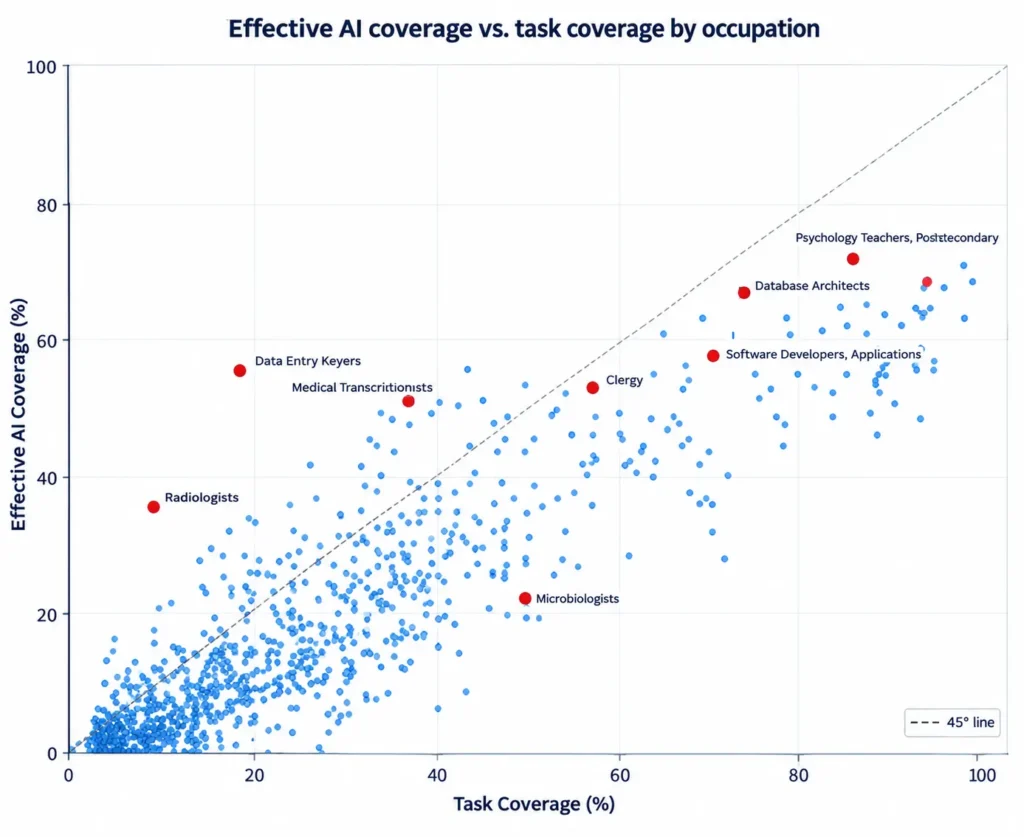
In its sample of Claude.ai conversations, augmentation accounted for approximately 52%, while automation accounted for approximately 45%.
Augmentation means AI assists someone with a task.
Automation means a user delegates more of the task to AI.
For example:
- Augmentation: An SEO professional uses Claude to analyze a Google Search Console export, then reviews the findings and decides which pages to optimize.
- Automation: A scheduled workflow processes the export, groups keywords, generates a report, and delivers it without requiring someone to perform every step manually.
Both reduce the time needed for certain activities.
However, Anthropic’s figures describe sampled Claude usage, not the percentage of jobs being automated across the economy.
The difference is important.
4. The skills required for jobs are changing
The World Economic Forum’s Future of Jobs Report 2025 projected significant changes in employment by 2030.
It estimated that 170 million jobs could be created and 92 million displaced worldwide, producing a net gain of 78 million jobs.
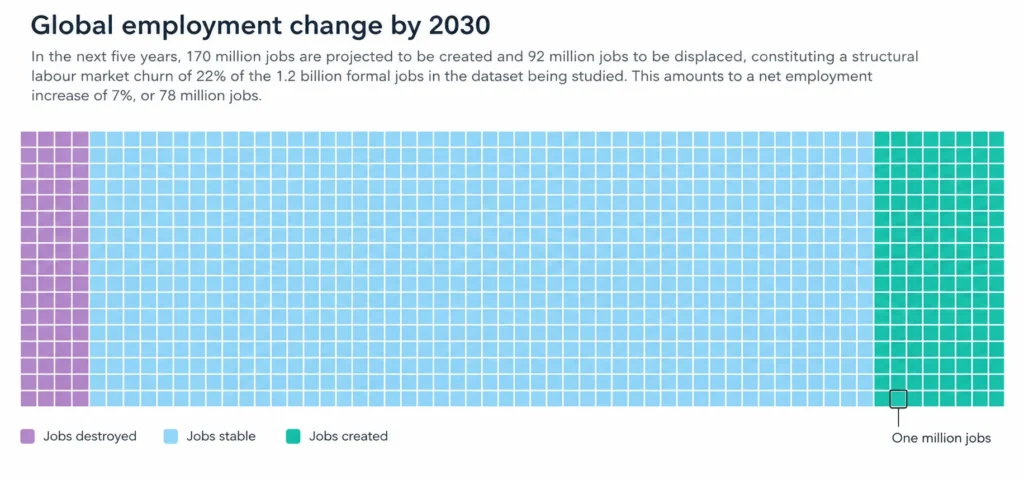
Those figures cover the broader labor market and multiple economic trends. They are not projections for digital marketing or the impact of AI alone.
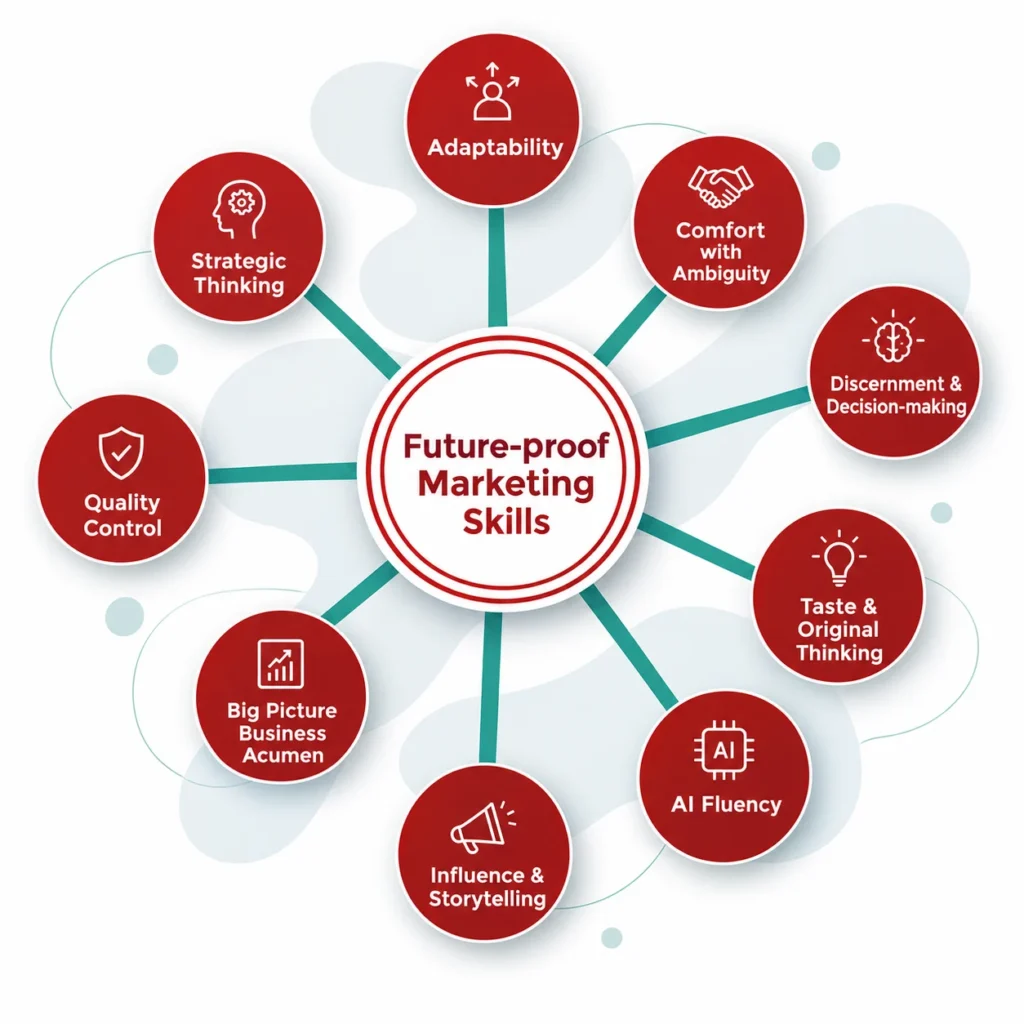
The report also highlighted the growing importance of technological literacy, AI, analytical thinking, creativity, and adaptability.
For digital marketers, the practical implication is straightforward.
Knowing how to perform a marketing task matters.
Knowing how to evaluate, improve, and connect that task to business outcomes may matter even more.
Which digital marketing jobs are most at risk from AI?
| Digital marketing activity | AI automation exposure | Why |
| Basic content drafting | High | AI can generate and rewrite text quickly |
| Routine social media captions | High | Repetitive writing and variations are easy to generate |
| Standard reporting | High | Data extraction and report generation can be automated |
| Basic keyword clustering | High | AI can classify and group large keyword lists |
| Routine ad copy variations | High | Advertising platforms and AI tools can generate multiple options |
| Technical SEO diagnosis | Moderate | AI can identify issues, but context and prioritization remain important |
| Campaign strategy | Moderate | AI supports analysis, but business decisions require judgment |
| Creative direction | Moderate | AI can generate concepts, but selecting effective ideas remains context-dependent |
| Marketing analytics | Moderate | Analysis can be automated, but measurement quality and interpretation matter |
| Client and stakeholder management | Lower | Requires communication, trust, negotiation, and accountability |
| Business growth strategy | Lower | Involves trade-offs, resource allocation, and commercial responsibility |
This is an LPT Skills qualitative assessment of task-level automation exposure as of October 2026, not a measured probability of job loss. The categories can change as AI tools improve.
Let’s examine the roles where these changes are particularly relevant.
1. Content writers who only produce basic articles
Content writing is one of the clearest examples of AI changing marketing work.
A company that previously needed several hours to produce a first draft can now generate one in minutes.
AI can also create outlines, rewrite paragraphs, prepare summaries, and produce variations for different audiences.
That creates pressure on content roles centered primarily on producing large volumes of generic material.
But generating an article isn’t the same as creating useful content.
Consider a blog post about Google’s latest advertising changes.
AI can produce a plausible explanation.
However, someone still needs to verify current product documentation, understand what changed, test relevant features, and explain how those changes affect advertisers.
Writers who can conduct original research, interview experts, work with real data, and explain complex subjects have skills that go beyond basic text generation.
What to learn: Research, subject expertise, fact-checking, content strategy, SEO, interviewing, and editorial judgment.
2. SEO executives doing repetitive optimization work
Many routine SEO tasks can now be assisted by AI.
For example:
- Grouping keywords by topic.
- Generating draft title tags and meta descriptions.
- Identifying content gaps from exported data.
- Suggesting internal linking opportunities.
- Creating schema markup drafts.
- Summarizing crawl reports.
- Writing small scripts for data processing.
These tasks previously required considerable manual effort.
But SEO also involves questions that don’t have straightforward answers.
- Why did organic traffic decline after a website migration?
- Why is Google indexing the wrong version of certain pages?
- Why are rankings improving while leads are falling?
- Which technical problems should a development team fix first?
AI can help investigate these questions, but its answers still require verification.
And decisions often depend on business priorities, website architecture, implementation constraints, and the reliability of the available data.
What to learn: Technical SEO, Google Search Console, analytics, Python or automation fundamentals, AI search, and strategic prioritization.
3. PPC executives performing only routine campaign management
Paid advertising platforms have been introducing automation for years.
Google Ads already includes automated bidding, Performance Max campaigns, and AI-assisted creative features.
Meta also offers Advantage+ features that automate elements of advertising delivery and optimization.
This means some activities that previously required manual intervention can now be handled by platform algorithms.
For instance, advertisers don’t necessarily need to adjust individual keyword bids manually throughout the day.
But campaigns still need to be connected to actual business outcomes.
Imagine an advertiser generating 1,000 leads at ₹100 per lead.
The campaign appears successful if you’re only looking at cost per lead.
But suppose 900 of those leads are irrelevant, and only ten become customers.
A marketer needs to investigate the quality of leads, conversion tracking, audience intent, sales feedback, and profitability.
An algorithm can optimize for the signals it receives, but those signals may not reflect the business’s real objectives.
What to learn: Conversion tracking, GA4, GTM, CRM integration, landing page optimization, profitability analysis, and campaign experimentation.
4. Social media executives focused on repetitive publishing
AI tools can generate captions, suggest hashtags, prepare content calendars, resize creative assets, and schedule posts.
This reduces the effort needed for routine social media production.
But successful social media marketing involves more than publishing content.
A professional needs to understand the audience, identify relevant conversations, evaluate creative ideas, respond appropriately to customers, and develop a consistent brand identity.
AI-generated content can be useful, but volume alone doesn’t guarantee relevance or engagement.
What to learn: Audience research, creative strategy, video content, community management, platform analytics, and brand communication.
5. Marketing analysts producing routine reports
Reporting is another area where AI can reduce repetitive work.
For example, a workflow can pull data from multiple sources, calculate performance metrics, identify unusual changes, and draft a summary.
However, reports are only useful when the underlying measurements are reliable.
Suppose a company’s conversion rate suddenly doubles.
Is the marketing working better?
Or did someone accidentally configure the same purchase event to fire twice?
A reporting tool may correctly describe what the recorded data shows while missing a measurement problem.
Marketing analysts need to validate the data, investigate anomalies, understand attribution limitations, and help teams make better decisions.
What to learn: GA4, GTM, SQL, data quality, attribution, experimentation, and business analytics.
Which digital marketing skills will remain valuable despite AI?
The common factor across the previous examples is that AI can produce outputs, but businesses still need people who can evaluate whether those outputs are useful.
Here are six capabilities worth developing.
1. Understanding customer behavior
Marketing starts with understanding customers.
- Why do people choose one product over another?
- What concerns prevent someone from making a purchase?
- Why does a customer abandon a form or shopping cart?
AI can analyze customer feedback and suggest patterns, but those suggestions need to be interpreted in the context of real people and real business situations.
Customer interviews, sales conversations, market research, and practical experience remain useful.
2. Connecting marketing with business results
A campaign generating 10,000 clicks may look impressive.
But what if those visitors don’t become customers?
A capable marketer needs to understand the difference between activity metrics and business outcomes.
This includes concepts such as customer acquisition cost, conversion rate, customer lifetime value, gross margin, and revenue attribution.
The closer your work is connected to meaningful business decisions, the more evidence you can provide of your contribution.
3. Analytical thinking
AI can identify patterns and generate summaries.
But you need to know what to investigate.
For example, if leads decline by 30%, several explanations are possible:
- Search demand has fallen.
- Campaign budgets have changed.
- Conversion tracking is broken.
- Landing pages aren’t working properly.
- Competitors have increased advertising activity.
- Lead quality definitions have changed.
A marketer should know how to test these possibilities systematically.
4. Creative problem-solving
AI can generate dozens of advertising concepts.
It doesn’t automatically know which one will connect with a specific audience.
Creative thinking involves understanding the audience, the product, the context, and the message.
And sometimes the best idea comes from questioning the original brief rather than generating more variations of it.
5. Communication and collaboration
Digital marketing rarely happens in isolation.
SEO professionals work with developers and content teams.
Performance marketers coordinate with designers, analysts, and sales teams.
Marketing managers need to explain priorities, negotiate resources, and communicate results.
These responsibilities involve relationships and accountability that are difficult to reduce to automated outputs.
6. AI literacy and automation
Avoiding AI isn’t a useful long-term strategy.
Learn how to use it responsibly.
Understand prompt design, model limitations, data privacy, workflow automation, and how to verify generated results.
You don’t need to become an AI engineer to benefit from these capabilities.
But you should be able to identify where AI improves your work and where human review is necessary.
Will AI reduce entry-level digital marketing jobs?
AI could reduce demand for certain entry-level tasks, making it harder for some beginners to enter the profession through traditional execution-heavy roles.
Consider a marketing agency that previously assigned junior employees to keyword categorization, routine content production, or manual reporting.
If AI handles a significant portion of this work, the agency may need fewer working hours to deliver the same output.
That might result in smaller teams, changed responsibilities, or higher expectations from new hires.
But it doesn’t mean all entry-level positions disappear.
Businesses still need people who understand their products, learn their processes, communicate with customers, and gradually develop expertise.
The challenge is that beginners may be expected to demonstrate more practical capability earlier in their careers.
What should freshers do differently?
If you’re planning to start a digital marketing career, don’t build your entire skill set around activities that AI can perform easily.
Instead, combine basic marketing knowledge with practical projects.
For example, if you’re learning SEO:
- Build a small website.
- Perform keyword research using traditional and AI-assisted methods.
- Publish useful content.
- Configure Google Search Console.
- Review indexing and search performance.
- Document what worked and what didn’t.
- Explain how you verified AI-generated recommendations.
This demonstrates more than your ability to generate an SEO report.
It shows that you understand the underlying process.
The same principle applies to performance marketing, analytics, and content strategy.
How AI is changing different digital marketing careers
| Career | Traditional work | Increasingly AI-assisted work |
| SEO | Manual keyword grouping, routine audits | Data classification, draft recommendations, automated checks |
| Performance Marketing | Manual bidding, repetitive campaign adjustments | Automated bidding, targeting assistance, creative generation |
| Content Marketing | First drafts, rewriting, basic research | Draft generation, summaries, content repurposing |
| Social Media | Captions, scheduling, basic creatives | Automated scheduling, generative content |
| Analytics | Manual data collection and reporting | Automated dashboards, data summaries |
| Email Marketing | Drafting sequences, basic segmentation | Personalized content, automated workflows |
An important point: AI capabilities don’t necessarily translate into immediate adoption.
Some businesses lack reliable data, technical expertise, integrated systems, or the budget to implement automation.
Others may avoid particular tools because of privacy, accuracy, regulatory, or brand risks.
So the pace of change will vary across companies and industries.
Will AI create new digital marketing jobs?
AI may create demand for new responsibilities and specializations, but we should be careful about promising that every displaced job will be replaced by a new one.
The American Marketing Association’s 2026 research identified emerging opportunities involving AI workflows and agentic commerce.
In practical terms, several areas are worth watching.
1. AI SEO and Generative Engine Optimization
Businesses are increasingly interested in how their brands appear in AI-generated search experiences.
This creates work involving AI-search visibility, content discoverability, technical SEO, brand representation, and measurement.
However, GEO is still evolving, and companies don’t always use the same job titles or metrics.
Strong traditional SEO skills remain relevant.
2. AI marketing automation
Some professionals are beginning to design workflows that connect AI tools with marketing systems.
For example, a workflow might collect performance data, classify campaign issues, prepare a report, and flag changes requiring review.
Building reliable systems requires knowledge of marketing, data, automation platforms, and quality control.
3. Marketing measurement and AI analytics
As platforms automate more campaign decisions, businesses need reliable data to guide those systems.
This makes measurement architecture, conversion tracking, customer data quality, and analytics valuable areas of expertise.
4. AI-assisted creative strategy
AI makes it easier to generate creative variations.
But businesses still need to understand which ideas resonate with customers and how to evaluate creative performance.
Professionals who combine audience research, experimentation, and creative judgment may find opportunities in this area.
5. AI workflow management
As AI becomes integrated into marketing operations, companies may need people who can assess tools, design processes, evaluate output quality, and manage risks.
These responsibilities may exist within traditional roles rather than as entirely new job titles.
That’s why it’s more useful to focus on capabilities than assume every emerging trend will become a large standalone profession.
How to protect your digital marketing career from AI: A practical 90-day plan
If you’re concerned about the future of your job, the most useful response is to start developing relevant capabilities.
This is a realistic 90-day plan for an existing marketing professional.
Days 1–30: Identify what AI can improve in your current work
Start by reviewing how you spend your time.
Separate your activities into three groups.
- Repetitive tasks: Work such as categorizing data, formatting reports, and preparing routine drafts.
- Analytical tasks: Activities such as investigating performance, interpreting data, and identifying problems.
- Strategic tasks: Work involving priorities, business decisions, communication, and planning.
Choose two or three repetitive activities that could benefit from AI assistance.
For example, an SEO specialist could test AI-assisted keyword clustering or Google Search Console data analysis.
Measure how much time the process takes before and after introducing AI.
Also record mistakes, additional review time, and the quality of the output.
The goal isn’t simply to use AI. It’s to determine whether AI actually improves the workflow.
Days 31–60: Build one advanced skill
Choose an area relevant to your specialization.
- If you work in SEO, consider technical SEO, automation, or AI-search visibility.
- If you work in performance marketing, improve your knowledge of GA4, GTM, conversion tracking, and landing page optimization.
- If you work in content, focus on original research, editorial strategy, and content performance.
Spend time applying the skill to an actual project.
Avoid relying entirely on tutorials.
Days 61–90: Build a measurable improvement project
Use what you’ve learned to solve one meaningful problem.
Examples include:
- Automating a weekly marketing report while maintaining data accuracy.
- Improving a campaign’s conversion tracking.
- Identifying and fixing technical SEO issues.
- Reducing manual keyword research time without sacrificing quality.
- Building a better content research and fact-checking workflow.
Document the starting situation, changes made, outcomes, and limitations.
This provides evidence that you’re developing your skills rather than simply learning the names of new tools.
Should you still learn digital marketing in 2027?
Yes, digital marketing can still be worth learning in 2027.
But the expectations need to change.
If your plan is to learn a few tools, complete a certificate, and depend on routine execution work for the next ten years, that approach carries increasing risk.
If you’re interested in understanding customers, solving business problems, working with data, developing strategies, and using technology effectively, digital marketing remains a field worth exploring.
The biggest mistake would be treating AI and digital marketing as separate career choices.
AI is becoming part of digital marketing itself.
Someone learning paid advertising should understand automated bidding and conversion measurement.
Someone learning SEO should understand traditional search and emerging AI-search experiences.
Someone learning content marketing should understand both AI-assisted production and the importance of original research and factual accuracy.
At LPT Skills, our approach to digital marketing training emphasizes practical work, AI tools, live projects, and developing skills that can be applied to real marketing problems.
If you’re starting from zero, our guide on How to Become a Digital Marketer in India provides a step-by-step learning roadmap.
And if you’re evaluating career opportunities more broadly, read Is Digital Marketing a Good Career in 2027?
Final thoughts: Will AI replace digital marketers?
AI will replace or reduce the need for some digital marketing tasks. Some jobs may disappear, others may change, and new responsibilities will emerge.
What’s becoming less valuable is the ability to perform routine work without understanding why it matters.
What’s becoming more important is the ability to use technology, interpret information, solve problems, and make decisions that improve business outcomes.
That doesn’t mean every experienced marketer is safe or every beginner will find it easy to enter the industry.
The transition will create challenges, particularly for people whose jobs depend heavily on repetitive tasks.
But if you’re building a digital marketing career, you can respond by developing skills that make you more adaptable.
Learn the fundamentals. Use AI. Verify its outputs. Build practical experience. Understand the business behind the marketing.
Don’t build your career around a task that can be automated. Build it around problems you can learn to solve.
Frequently asked questions
No. AI will not eliminate digital marketing. AI can automate many marketing tasks, including drafting content, preparing reports, and optimizing certain advertising activities. However, strategy, business judgment, measurement, creativity, and stakeholder management remain important. The number and nature of jobs may still change substantially.
AI can automate or assist with keyword clustering, content drafting, technical checks, and reporting. However, complex technical SEO, strategic prioritization, troubleshooting, and understanding business outcomes still require expertise and oversight. SEO roles are likely to evolve, though demand for certain routine responsibilities may decline.
ChatGPT can assist with research, content creation, analysis, and workflow automation. It doesn’t independently replace every responsibility of a digital marketing professional. Its impact depends on how businesses integrate AI into their processes, which tasks they automate, and how roles are redesigned.
AI already automates parts of advertising through bidding, targeting, and creative systems. Google Ads professionals still need to understand conversion tracking, campaign objectives, budgets, customer acquisition economics, and performance measurement. Routine campaign management may require less manual work, making broader analytical skills increasingly useful.
Digital marketing is still a promising career for people who develop practical skills and adapt to new technology. However, the profession is changing, and some entry-level execution tasks may face increasing competition from automation. Learning AI alongside marketing fundamentals is a sensible approach.
Yes, although entry-level expectations may change as companies automate routine activities. Freshers can strengthen their applications through practical projects, internships, portfolios, and familiarity with relevant AI and marketing tools. Job availability will vary by city, specialization, and employer.
Digital marketing roles in India are likely to evolve as businesses adopt AI, automation, and more advanced measurement systems. Opportunities will differ by industry and company. Professionals who develop practical marketing expertise, analytical capabilities, and AI literacy may be better prepared for these changes.