
You don’t need a marketing degree, coding experience, or an expensive setup to start learning digital marketing.
But you do need more than a few online certificates.
If you look at what digital marketers actually do, you’ll find people running Google Ads campaigns, improving websites’ search visibility, analyzing customer journeys, creating content strategies, and helping businesses acquire customers.
These are different skills, and trying to learn all of them at once is overwhelming.
The best way to become a digital marketer in India is to learn the fundamentals, specialize in one area, work on real projects, build a portfolio, and gain practical experience through internships or entry-level roles.
With consistent effort, you can build a foundation and start applying for beginner opportunities within three to six months. Becoming genuinely proficient takes longer.
In this guide, I’ll walk you through a practical roadmap, including what to learn, which tools to use, how to practice without clients, and how to prepare for your first digital marketing job.
What does a digital marketer actually do?
A digital marketer helps businesses reach potential customers, generate demand, and achieve business goals through online channels.
Let’s understand this with an example.
Imagine you’re working with an education business that wants to generate 300 admissions enquiries every month.
Your job will involve:
- Finding what students search for on Google.
- Improving the institute’s website to attract relevant traffic.
- Running Google Ads for high-intent search queries.
- Creating Meta Ads campaigns to reach potential students.
- Optimizing landing pages to increase enquiries.
- Tracking how many leads convert into admissions.
- Analyzing campaign performance and recommending improvements.
You wouldn’t necessarily handle all these activities yourself.
A larger company might have separate SEO, paid advertising, content, design, and analytics teams.
A smaller business might expect one digital marketing executive to manage several channels.
The important distinction is that digital marketing isn’t simply posting on social media or running advertisements. It’s about using digital channels to achieve measurable business outcomes.
Different types of digital marketing jobs
These are some common roles you’ll encounter when exploring digital marketing careers in India.
| Role | What you primarily work on |
| Digital Marketing Executive | Multiple marketing channels, campaign execution, reporting |
| SEO Executive | Website optimization, keyword research, organic traffic |
| Performance Marketing Executive | Google Ads, Meta Ads, leads, conversions |
| Social Media Executive | Content calendars, social platforms, engagement |
| Content Marketer | Blog content, content strategy, audience acquisition |
| Marketing Analyst | GA4, reporting, dashboards, campaign data |
| Email Marketing Specialist | Email campaigns, customer journeys, automation |
You don’t need to choose your specialization immediately.
However, once you understand the basics, developing deeper expertise in one area will make your learning more focused.
Do you need a degree to become a digital marketer in India?
No specific degree is universally required to become a digital marketer in India.
Students from BCom, BA, BBA, BSc, BTech, and other academic backgrounds can learn digital marketing.
Some employers require a bachelor’s degree. Others place greater emphasis on practical experience, communication skills, technical knowledge, and project work.
For example, an employer hiring an SEO executive may be interested in whether you can:
- Perform keyword research.
- Audit a website.
- Identify technical SEO problems.
- Use Google Search Console.
- Explain why a page isn’t attracting organic traffic.
Your educational background can help, but it doesn’t automatically demonstrate these skills.
The same applies to paid advertising.
Knowing marketing terminology is useful, but an employer will also want to understand whether you can structure a campaign, track conversions, and interpret results.
What if you’re from a non-technical background?
That’s fine. Digital marketing includes technical and non-technical specializations.
You can start with content marketing, social media, or broader marketing fundamentals and gradually learn more technical skills.
Even technical SEO and analytics don’t necessarily require advanced programming knowledge at the beginner level.
Some familiarity with HTML, spreadsheets, website structures, and basic data concepts will help you progress.
Check out the detailed guide on Is Digital Marketing a Good Career.
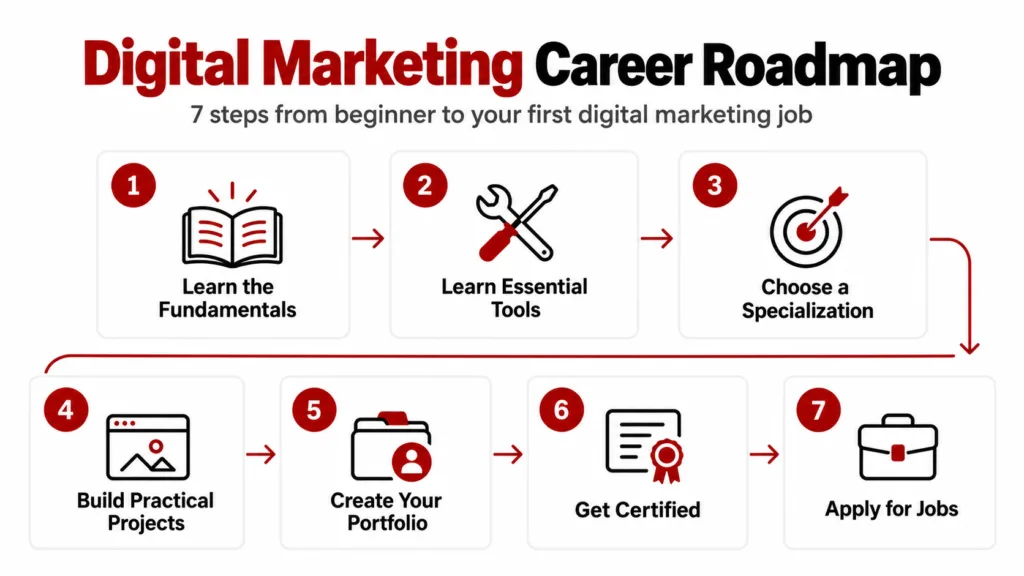
How to become a digital marketer? 7-step roadmap
Use the roadmap I recommend for someone starting from scratch.
| Step | What to do | Expected outcome |
| 1 | Learn digital marketing fundamentals | Understand how online marketing works |
| 2 | Learn essential marketing tools | Become familiar with practical workflows |
| 3 | Choose a specialization | Develop a focused skill set |
| 4 | Work on practical projects | Apply what you’ve learned |
| 5 | Build a portfolio | Demonstrate your capabilities |
| 6 | Earn relevant certifications | Validate foundational knowledge |
| 7 | Apply for internships and jobs | Gain professional experience |
These steps don’t have to happen strictly one after another. You can work on projects while learning tools and complete certifications alongside practical training.
Step 1: Learn the fundamentals of digital marketing
Before choosing between SEO, Google Ads, or social media marketing, understand how businesses use different digital channels.
Start with five areas.
1. Search Engine Optimization (SEO)
SEO helps websites improve their visibility in search engines.
You’ll learn how search engines discover pages, how people search for information, what makes content useful, and how websites can improve their organic search performance.
Start by understanding keyword research, search intent, on-page SEO, technical SEO fundamentals, and Google Search Console.
2. Paid advertising
Paid advertising involves paying platforms such as Google and Meta to show advertisements to relevant audiences.
Learn how campaigns are structured, how budgets work, what targeting means, and how advertisers measure results.
Understand metrics such as clicks, impressions, cost per click, cost per lead, and return on ad spend.
3. Social media marketing
Social media marketing involves building an audience, publishing relevant content, engaging with users, and supporting business objectives through social platforms.
Learn the differences between organic content, paid social campaigns, engagement, and conversions.
4. Content marketing
Content marketing focuses on creating and distributing useful content for a defined audience.
This might include blogs, videos, newsletters, social content, downloadable resources, and educational guides.
Understand audience research, content planning, distribution, and performance measurement.
5. Marketing analytics
Analytics helps marketers understand what happened after someone interacted with a campaign or website.
Start with traffic sources, user engagement, conversion events, and basic reporting.
You don’t need advanced statistical knowledge at this stage. You should, however, understand how to read numbers and ask useful questions.
Your goal in this first step: Understand how these channels work together.
For example, someone might discover a company through an Instagram Reel, search for its product on Google, visit the website, and eventually purchase after seeing a remarketing advertisement.
Digital marketing involves understanding and improving parts of that journey. You can learn all these in an offline or online digital marketing course.
Step 2: Learn the digital marketing tools used in actual jobs
Watching tutorials is helpful, but you also need experience using real software.
These are the tools worth exploring as a beginner.
| Category | Tools | What to learn |
| SEO | Google Search Console, Ahrefs, Semrush, Screaming Frog | Search performance, keyword research, audits |
| Paid advertising | Google Ads, Meta Ads Manager | Campaign setup, targeting, optimization |
| Analytics | GA4, Google Tag Manager | Measurement, tracking, reporting |
| Content | WordPress, Google Docs, Canva | Publishing, content creation |
| AI | ChatGPT, Claude, Gemini | Research assistance, analysis, automation |
| Spreadsheets | Google Sheets, Microsoft Excel | Data organization and analysis |
| Email marketing | Mailchimp, HubSpot | Email campaigns, automation |
You don’t need paid subscriptions to every tool.
Google Search Console, Google Analytics, Looker Studio, and many learning resources are available without subscription fees.
Start with the tools relevant to your chosen area.
For example, if you want to become an SEO executive, spending your first month mastering Meta Ads Manager probably isn’t the best use of your time.
Focus on Google Search Console, basic keyword research, WordPress, and SEO auditing first.
Learn AI tools alongside your marketing tools
AI is becoming part of everyday marketing work.
You can use ChatGPT or Claude to help organize research, examine data, draft content briefs, generate variations of advertising copy, and automate certain repetitive workflows.
But there’s an important difference between generating an output and knowing whether it’s correct.
Suppose you ask ChatGPT to analyze a list of keywords and group them by search intent.
It may produce a useful initial classification.
You still need to review whether the keywords belong together, whether the intent is accurate, and whether the proposed pages make sense.
Treat AI as an assistant that helps you work, not as a substitute for understanding marketing.
Step 3: Choose a digital marketing specialization
Once you understand the fundamentals, choose one area to explore more deeply.
This decision matters because different roles require different capabilities.
Below is a simple way to evaluate your options.
Choose SEO if you enjoy:
- Researching topics and search behavior.
- Working with websites.
- Solving technical and content problems.
- Analyzing organic search performance.
Choose performance marketing if you enjoy:
- Working with numbers.
- Testing advertisements.
- Managing budgets.
- Improving conversions and acquisition costs.
Choose content marketing if you enjoy:
- Writing and research.
- Understanding audiences.
- Developing content strategies.
- Explaining complex subjects.
Choose marketing analytics if you enjoy:
- Working with datasets.
- Creating dashboards.
- Identifying trends and patterns.
- Investigating performance problems.
Choose social media marketing if you enjoy:
- Creative communication.
- Understanding platform behavior.
- Developing content concepts.
- Working on audience engagement.
You can move between specializations later.
An SEO professional may develop expertise in analytics. A content marketer may transition into SEO. A paid advertising specialist may eventually become a growth marketer.
For now, selecting one primary specialization will help you build stronger practical skills.
Step 4: Work on real digital marketing projects
This is probably the most important step in your learning journey.
You can understand marketing concepts and still struggle to apply them.
Projects help bridge that gap.
And you don’t need to wait until someone hires you.
Here are three beginner-friendly projects you can start with.
Project 1: Create and optimize a website
Build a simple website around a subject you’re familiar with.
For example, you could create a website about fitness, local travel, technology, or career guidance.
WordPress is a reasonable option for beginners.
Once the website is ready:
- Create five useful pages or articles.
- Research relevant keywords and search intent.
- Write descriptive page titles and headings.
- Create a logical internal linking structure.
- Set up Google Search Console.
- Submit your XML sitemap.
- Check whether Google can discover and index your pages.
- Monitor organic search performance.
Don’t worry if your website doesn’t start ranking immediately.
The objective is to understand the process and learn how to diagnose problems.
Document what you changed and what happened.
Project 2: Analyze a digital advertising campaign
You don’t necessarily need to spend money immediately.
Start by creating a campaign plan for a hypothetical business.
Suppose a local gym wants to generate enquiries for new memberships.
Create a campaign plan covering:
- The business objective.
- Target audience.
- Suggested advertising platform.
- Campaign structure.
- Advertising copy.
- Landing page concept.
- Proposed budget.
- Conversion tracking plan.
- Metrics you’ll use to evaluate performance.
You can also create a sample landing page.
If you later get permission to run a campaign for a real business, you’ll have the opportunity to compare your plan with actual results.
Don’t invent impressions, clicks, leads, or revenue figures for a portfolio project that hasn’t run. Label simulated examples clearly.
Project 3: Create a marketing analytics dashboard
Marketing teams rely on reporting to understand performance.
You can practice by using the Google Analytics demo account or another legitimate sample dataset.
Build a dashboard in Looker Studio showing:
- Website traffic.
- Traffic sources.
- Engagement.
- Important events or conversions.
- Performance over time.
Then write a short analysis explaining what the data tells you.
For example, imagine organic search brings 60% of website sessions but accounts for only 20% of reported conversions.
What would you investigate?
You might look at landing pages, traffic intent, conversion tracking, and how different channels contribute to the customer journey.
It’s this kind of reasoning that makes a dashboard project useful.
Step 5: Build a portfolio before applying for jobs
A portfolio gives employers evidence of what you can do.
It can be especially useful when you’re applying for your first digital marketing internship or job and don’t have formal experience.
You don’t need a sophisticated portfolio website.
A clean Notion page, Google Drive folder, or simple personal website is enough to get started.
Here’s a useful structure.
“Project title: SEO Audit for a Local Business Website
Objective: Identify opportunities to improve the website’s search visibility.
Tools used: Google Search Console (if access was authorized), Screaming Frog, Google Sheets, and other relevant tools.
Work completed: Reviewed page structure, technical accessibility, internal linking, content quality, and search intent.
Findings: Documented important issues and proposed fixes.
Outcome: Explained which recommendations were implemented, what changed, and what still needs further testing.”
Include screenshots, spreadsheets, audit summaries, or links to the work wherever appropriate.
Don’t include confidential business data without permission.
What makes a portfolio convincing?
A good case study explains your reasoning.
Instead of writing:
“Performed keyword research for a website.”
Show the keywords you selected, explain why they matter, demonstrate how you grouped them, and describe what pages you recommended.
Instead of writing:
“Created Google Ads campaigns.”
Explain the campaign objective, structure, targeting decisions, conversion setup, and how you’d evaluate performance.
Employers can learn much more about your abilities from these details than from a long list of tools.
Expert Insight: What Makes a Beginner Stand Out in Digital Marketing Hiring?
“One thing I’ve learned from hiring and managing digital marketing professionals is that knowing a tool and knowing how to use it to solve a business problem are two very different things.
When evaluating beginners, I look for curiosity, clarity of thought, and evidence that they’ve actually worked on something.
A candidate who can walk me through a website audit, explain why they selected certain keywords, or identify what’s wrong with a campaign gives me much more to evaluate than someone who simply lists ten certifications on their resume.
You don’t need to know everything when you start. But you should be able to explain what you’ve learned, how you’ve applied it, and what you’d do differently next time.”
— Virendra Soni, SEO & Content Marketing Head, LPT | 10+ Years of Digital Marketing Experience
Step 6: Complete relevant digital marketing certifications
Certifications can help you organize your learning and demonstrate familiarity with particular platforms.
They’re especially useful when you’re starting without professional experience.
But you don’t need to collect every certification available.
Start with courses that support your specialization.
| Certification or training | Provider | Suitable for |
| Google Ads Certifications | Google Skillshop | Paid advertising beginners |
| Google Analytics Certification | Google Skillshop | Analytics and measurement |
| Digital Marketing Certification | HubSpot Academy | Marketing fundamentals |
Google provides Google Ads training and certifications through Skillshop. Its Google Ads certifications require passing an assessment and are generally valid for one year.
Google also offers free Analytics Academy training and a Google Analytics certification.
HubSpot Academy offers a free digital marketing certification course covering areas such as SEO, social media, and digital marketing strategy.
Do certificates help you get a job?
They can support your application, but they don’t guarantee employment.
A Google Ads certificate suggests you’ve demonstrated knowledge of the platform’s concepts. It doesn’t necessarily prove that you can profitably manage a client’s advertising budget.
Combine certifications with practical projects and examples of your work.
Step 7: Apply for internships and entry-level digital marketing jobs
Once you’ve developed foundational skills and completed a few projects, start exploring professional opportunities.
You don’t need to wait until you know every digital marketing tool.
Look for roles that match your strongest skills.
Common entry-level job titles include:
- Digital Marketing Intern
- Digital Marketing Trainee
- SEO Intern
- SEO Executive
- Performance Marketing Intern
- Social Media Executive
- Content Marketing Intern
- Junior Digital Marketing Analyst
You can search on LinkedIn, Naukri, Indeed, Internshala, and company career pages.
Don’t rely entirely on submitting applications through job portals.
If you’ve completed a relevant project, consider contacting agencies or businesses with a concise message explaining your interests and sharing your portfolio.
For example:
“I’ve been learning SEO and recently completed a technical and content audit of a business website. I’ve documented the findings and recommendations in a short case study. I’m looking for an SEO internship where I can work on real websites and develop my skills further.”
This gives the employer something concrete to evaluate.
Agency or in-house: Where should you start?
Both can be good options.
At an agency, you may get exposure to multiple industries, clients, tools, and projects.
In an in-house role, you may get more time to understand one business and see how marketing contributes to its long-term goals.
The quality of the manager and the work you’ll actually perform matters more than the label.
Before accepting an internship, ask:
- Will I work on live campaigns or websites?
- Who will review my work?
- What tools will I get access to?
- Will I receive regular feedback?
- What skills should I expect to develop?
- Is there a possibility of moving into a full-time position?
An internship where you spend months doing repetitive work without feedback may not help you progress as much as you expect.
Read in detail about Will AI replace digital marketing jobs!
A practical 90-day digital marketing learning plan
If you’re unsure where to begin, here’s a structured 90-day plan.
It’s designed for a motivated beginner who can dedicate approximately 1.5–2 hours per day to learning and practice.
It isn’t a guarantee of becoming job-ready in 90 days. The objective is to build enough knowledge and project experience to start pursuing suitable beginner opportunities.
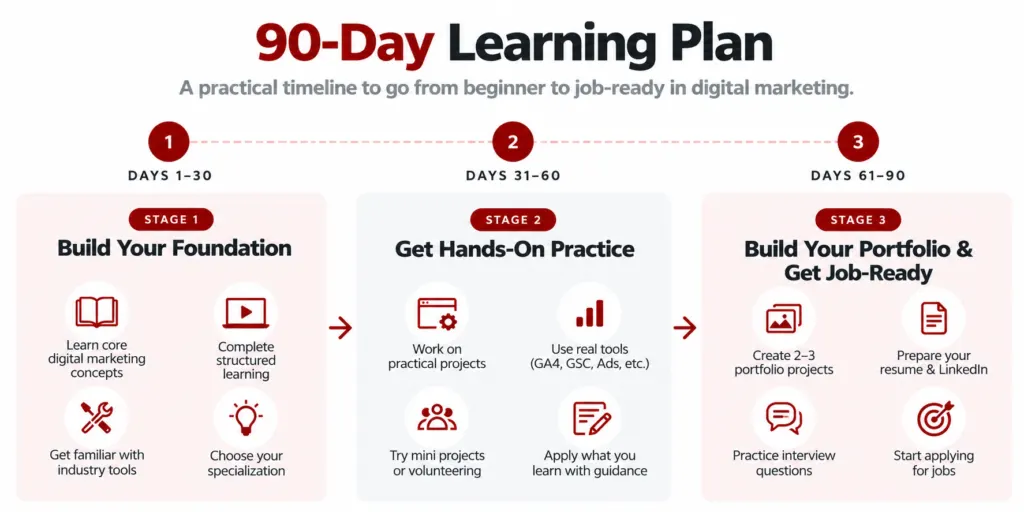
Days 1–30: Build your foundation
| Week | Focus | What you should complete |
| 1 | Digital marketing fundamentals | Understand major channels and marketing metrics |
| 2 | SEO and content | Basic keyword research and website optimization |
| 3 | Paid advertising | Understand Google Ads and Meta Ads campaign structures |
| 4 | Analytics and AI | Learn GA4 basics, reporting, and AI-assisted workflows |
Your target by day 30: Understand how digital marketing works and identify one specialization you want to pursue.
Days 31–60: Develop practical skills
| Week | Focus | What you should complete |
| 5 | Specialization | Study one marketing discipline more deeply |
| 6 | Tools | Complete hands-on exercises using relevant platforms |
| 7 | Project 1 | Create a website, audit, campaign plan, or other practical project |
| 8 | Project 2 | Complete a second project or extend the first |
Your target by day 60: Have at least one complete project and a second project underway, with clear documentation of your work.
Days 61–90: Build proof and start applying
| Week | Focus | What you should complete |
| 9 | Portfolio | Publish two or three documented projects |
| 10 | Certification | Complete one relevant platform certification |
| 11 | Resume and LinkedIn | Create a skills-focused resume and improve your profile |
| 12–13 | Applications | Apply for relevant internships and beginner roles |
Your target by day 90: Have a portfolio, an updated resume, and a clear understanding of the skills you still need to improve.
If you find that your work isn’t yet strong enough for interviews, continue developing your projects rather than rushing through more certificates.
How much does it cost to learn digital marketing in India?
You can start learning digital marketing without spending a large amount of money.
Google, HubSpot, Meta, and other platforms publish free educational resources. Many tools also have free versions or demo environments.
However, free learning and structured professional training offer different experiences.
Below is how to evaluate your options.
| Learning method | Advantages | Limitations |
| Free online resources | Low cost, flexible schedule | Requires self-discipline and independent project planning |
| Recorded courses | Structured lessons, learn at your pace | Limited real-time feedback |
| Live online courses | Instructor interaction, structured learning | Quality and hands-on access vary |
| Offline classroom training | In-person guidance, peer interaction, supervised practice | Requires travel and fixed attendance |
| Internships | Experience with actual business work | Learning quality and compensation vary |
If you’re comfortable learning independently, you can begin with free resources and build projects.
If you prefer structured training, mentorship, and feedback on your work, a practical course is useful.
For example, the LPT Skills Digital Marketing Online Course is a four-month, live mentorship program that includes practical training, live projects, LMS access, internship opportunities, and placement support.
When comparing any course, look beyond its list of modules.
Ask whether you’ll work on real websites, set up campaigns, learn analytics, receive feedback, and create portfolio-worthy projects.
A course is valuable when it helps you develop capabilities you can actually use.
How to prepare for your first digital marketing interview?
Many beginners spend months learning tools but very little time preparing to explain their work.
That’s a mistake.
An interviewer may ask you to describe a project, explain a metric, diagnose a problem, or recommend an approach.
Here are some questions worth practicing.
1. What’s the difference between SEO and Google Ads?
SEO focuses on improving visibility in unpaid search results. Google Ads allows advertisers to pay for eligible ad placements.
The channels differ in cost structure, measurement, and how visibility is earned.
A useful answer would also explain when a business might use both.
2. How would you increase traffic to a new website?
Don’t immediately answer, “I’ll do SEO.”
First clarify the business, audience, objective, current website condition, and available resources.
Then explain how you’d research demand, improve the website, develop useful content, and choose relevant acquisition channels.
3. What would you do if a Google Ads campaign generated clicks but no conversions?
Possible causes include poor search intent, an ineffective landing page, technical issues, inaccurate conversion tracking, or a mismatch between the advertisement and the offer.
A strong answer explains how you’d investigate the problem rather than assuming one cause.
4. Which digital marketing tools have you used?
Mention tools you’ve actually worked with.
If you’ve only used a demo account or completed a guided exercise, explain that clearly.
It’s better to show a small amount of genuine hands-on experience than claim expertise you can’t demonstrate.
5. Tell me about a marketing project you’ve completed.
Use a simple structure:
- Problem
- Approach
- Execution
- Result
- Learning
Explain what you tried, why you tried it, what happened, and what you’d change next time.
Even an unsuccessful project can be useful if you learned something meaningful and can explain your reasoning.
Mistakes to avoid when starting a digital marketing career
I’ve covered what you should do. Here are a few things worth avoiding.
1. Learning every tool without mastering one
You don’t need to become an expert in SEO, Google Ads, Meta Ads, analytics, automation, and graphic design before applying for your first job.
Develop a reasonable understanding of the field, then build depth in one area.
2. Collecting certificates without practicing
Completing a course feels productive.
But if you can’t explain how to use what you’ve learned, the certificate alone won’t help much during an interview.
Pair every learning module with an exercise or project.
3. Depending entirely on AI-generated work
AI can help you work faster, but it can also make mistakes.
If you submit an AI-generated SEO audit or campaign plan without understanding it, you may struggle when an interviewer asks why you made a recommendation.
Use AI to assist your learning, not replace it.
4. Expecting immediate results
SEO projects may take time to produce measurable results. Advertising campaigns require proper tracking, optimization, and sufficient data.
Similarly, finding your first job may take more than a few applications.
Focus on improving the quality of your work and learning from feedback.
5. Paying for promises instead of training quality
Be cautious about courses that promise unusually high salaries, guaranteed jobs without conditions, or expert-level skills in an unrealistic timeframe.
Evaluate the curriculum, trainers, practical assignments, internship structure, placement support, fees, and any written terms before enrolling.
What should you do after getting your first digital marketing job?
Your first job is the beginning of your learning, not the end.
During your first year, focus on understanding how real marketing teams operate.
Learn how campaigns are planned, how performance is measured, how work gets reviewed, and how marketing decisions connect with business objectives.
Try to own small projects and become reliable at delivering them.
As your experience grows, you’ll be able to take responsibility for more complex work.
Final thoughts: You can start learning digital marketing today!
You don’t need to know everything before you start.
Learn how digital marketing works. Choose a specialization. Get comfortable with the tools. Work on actual problems. Build projects that demonstrate your skills.
Then start applying for opportunities where you can learn from experienced professionals.
If I were starting from zero, I’d spend less time collecting certificates and more time creating something I could confidently explain in an interview.
A well-documented website audit, a thoughtfully planned advertising campaign, or a useful analytics dashboard can say much more about your abilities than a resume filled with tool names.
Start with one skill. Build one project. Improve it. Then move to the next.
That’s a practical way to begin your digital marketing career in India.
Frequently asked questions
You can begin learning digital marketing after completing Class 12. Start with the fundamentals of SEO, social media, paid advertising, content, and analytics. Practice through small projects and consider introductory courses or internships where eligible. Some employers may require a bachelor’s degree for full-time positions.
Learn the fundamentals, choose a specialization, and create projects that demonstrate your skills. Build a portfolio, complete relevant certifications, and apply for internships or trainee roles. You don’t need paid client experience to start learning, but practical work can strengthen your applications.
You can develop foundational knowledge in approximately three to six months with consistent study and practice. The time needed to become job-ready varies by your background, specialization, training quality, and project experience. Developing advanced expertise generally takes years of professional work.
Yes. Most digital marketing roles don’t require programming. However, basic knowledge of HTML, website structure, tracking, and data can help, particularly in SEO, analytics, and performance marketing. Advanced technical skills become more useful in specialized roles.
Important skills include understanding marketing fundamentals, research, communication, analytics, problem-solving, and familiarity with relevant digital platforms. Depending on your specialization, you may also need SEO, Google Ads, Meta Ads, GA4, content creation, or automation skills.
Yes. Commerce students may find concepts such as budgets, profitability, customer acquisition, and marketing performance familiar. They can explore performance marketing, analytics, SEO, content, and other specializations. Practical training and relevant projects remain important regardless of academic background.
If you’re more interested in websites, research, and organic search, SEO may be a suitable starting point. If you enjoy paid campaigns, numbers, and experimentation, explore Google Ads. Both are valuable, and learning basic analytics will help you in either specialization.
Yes, but freelancing requires more than marketing knowledge. You’ll also need to find clients, scope projects, communicate clearly, manage expectations, and deliver reliable work. Gaining practical experience through internships, employment, or supervised projects can help before taking responsibility for paying clients.
No. AI can automate tasks and assist with research, content, advertising, and analytics, but you still need to understand marketing objectives, customers, measurement, and decision-making. Learning to use AI effectively alongside marketing fundamentals is a more useful approach than relying on automated outputs alone.