
Digital marketing is changing faster than ever. AI can write blog posts, create ad campaigns, analyze data, and automate tasks that previously took marketers hours.
So, if you’re planning to start a digital marketing career in 2027, you probably have a few questions.
- Will there still be enough jobs?
- Is the salary worth it?
- Will AI make your skills irrelevant before you’ve even built a career?
Yes, digital marketing is still a promising career choice for 2027. Businesses continue to invest in online advertising, customer acquisition, and digital growth. But the skills employers value are changing. Knowing how to use marketing tools is no longer enough. You also need to understand data, customer behavior, AI, and how marketing contributes to revenue.
There are opportunities for beginners, experienced professionals, and people switching careers. However, the path to becoming a successful digital marketer is becoming more demanding.
Let’s look at the actual opportunities, salaries, challenges, and skills you’ll need to build a career in digital marketing in 2027.
Why digital marketing is still a promising career in 2027?
The strongest reason to consider a career in digital marketing isn’t the popularity of social media or the number of online courses available. It’s that businesses need customers.
Whether a company sells software, clothes, insurance, educational courses, or real estate, it needs ways to attract people, generate leads, and convert them into paying customers.
Digital marketing helps businesses do that, with more measurable results than traditional advertising.
And the amount businesses spend on digital advertising continues to grow.
1. Digital advertising spending is growing in India
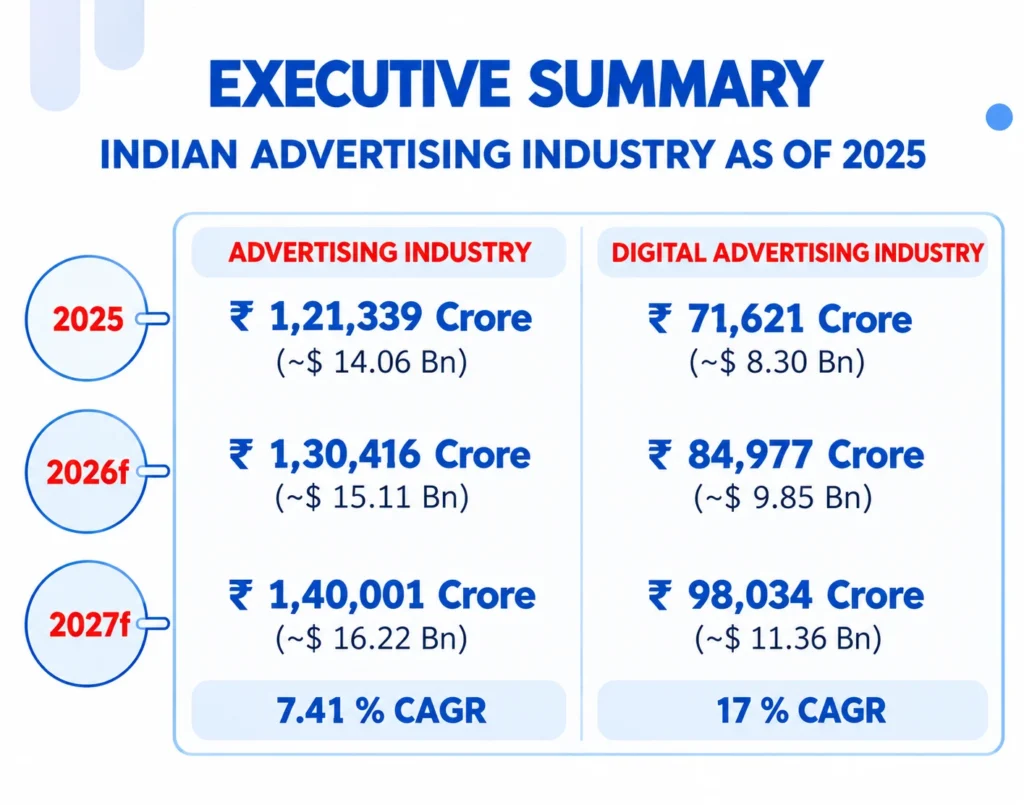
According to the dentsu Digital Advertising Report 2026, India’s digital advertising expenditure reached approximately ₹71,621 crore in 2025, accounting for about 59% of total advertising spending.
The report projects that digital advertising expenditure could reach approximately ₹98,034 crore by 2027.
That’s a projected increase of approximately 37% over two years.
The numbers don’t mean digital marketing jobs will increase by the same percentage. Advertising budgets and employment levels are different things.
But they do show that businesses are expected to continue investing heavily in digital channels.
And spending that money effectively requires people who understand campaign strategy, audience targeting, content, analytics, and conversion optimization.
2. Digital marketing isn’t limited to technology companies
One of the useful things about learning digital marketing is that your skills can apply across industries.
For example:
- E-commerce: An online clothing brand needs Google Shopping campaigns, Meta Ads, SEO, and customer retention strategies.
- Education: A coaching institute needs organic search traffic, lead generation, paid campaigns, and marketing automation.
- Real estate: A developer needs qualified leads, landing pages, and advertising campaigns.
- SaaS: A software company needs content marketing, product-led acquisition, paid search, and lifecycle marketing.
- Healthcare: A hospital or clinic may need local SEO, educational content, and patient acquisition campaigns.
The tools and strategies vary, but the underlying objective is similar: reach the right audience and generate business.
This gives digital marketers flexibility to work in different industries instead of being tied to one sector.
3. You don’t have to follow one career path
Digital marketing offers several ways to build a career.
You can work at a marketing agency, join an in-house marketing team, specialize in one channel, work independently as a consultant, or eventually start an agency or business.
Each option has trade-offs.
Agencies can expose you to multiple clients and industries. In-house roles may let you understand one business more deeply. Freelancing offers independence but also requires client acquisition, communication, and financial discipline.
You can also switch between these paths as your experience grows.
That flexibility is one of digital marketing’s advantages, although it doesn’t guarantee job security or consistent income.
Check out the detailed guide on How to become a Digital Marketer.
Will AI replace digital marketing jobs by 2027?
AI is already changing digital marketing jobs. Ignoring that would be misleading.
Tools such as ChatGPT, Claude, Gemini, and the AI features built into advertising platforms can handle many tasks that marketers previously performed manually.
For example, AI can help you:
- Generate content briefs and first drafts.
- Organize keywords into topic clusters.
- Create variations of advertising copy.
- Summarize campaign performance.
- Analyze datasets and identify patterns.
- Automate repetitive reporting tasks.
- Generate creative concepts and images.
Someone who previously spent several hours organizing keyword research might now complete the first version of that work much faster.
That creates a legitimate concern for people entering the industry.
If software can perform these tasks, why would a company hire a beginner?
AI is changing the value of marketing skills
Consider two SEO professionals.
The first knows how to find keywords, write basic meta tags, and generate blog content.
The second can diagnose why a website is losing organic traffic, identify technical problems, understand search intent, develop a content strategy, and connect SEO performance with leads and revenue.
AI can assist both.
But the second professional brings judgment and decision-making skills that are harder to automate reliably.
The same applies to performance marketing.
AI can help automate bidding and campaign optimization. But someone still needs to evaluate whether the leads are valuable, whether the tracking is accurate, and whether the campaign is profitable.
The career opportunity is increasingly in understanding what needs to be done, why it matters, and whether it worked.
What does the employment research say?
The World Economic Forum’s Future of Jobs Report 2025 estimates that nearly 40% of workers’ existing skills could change by 2030.
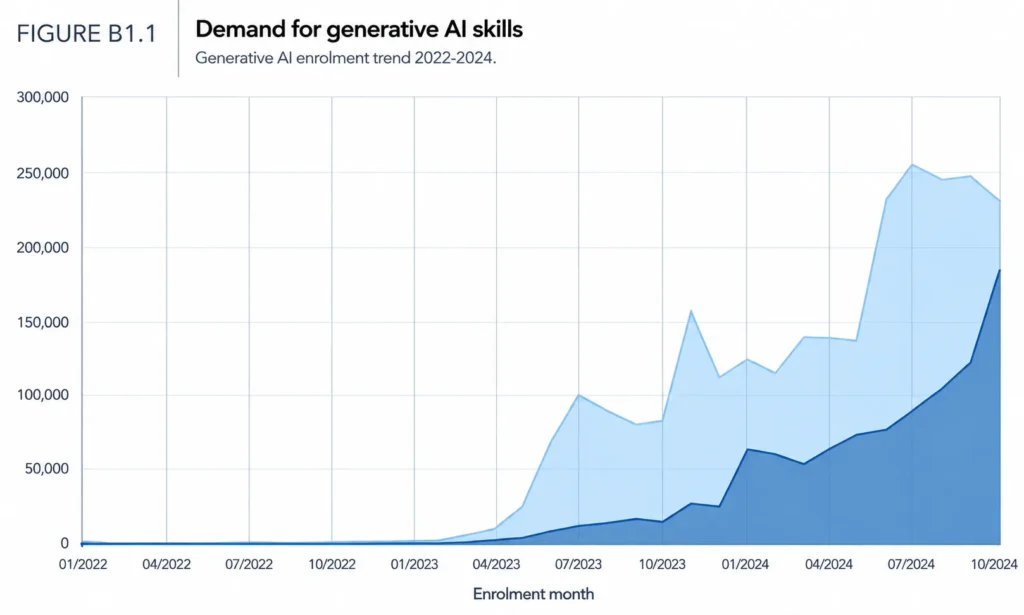
It also identifies AI, big data, technological literacy, creative thinking, and analytical thinking among the capabilities expected to grow in importance.
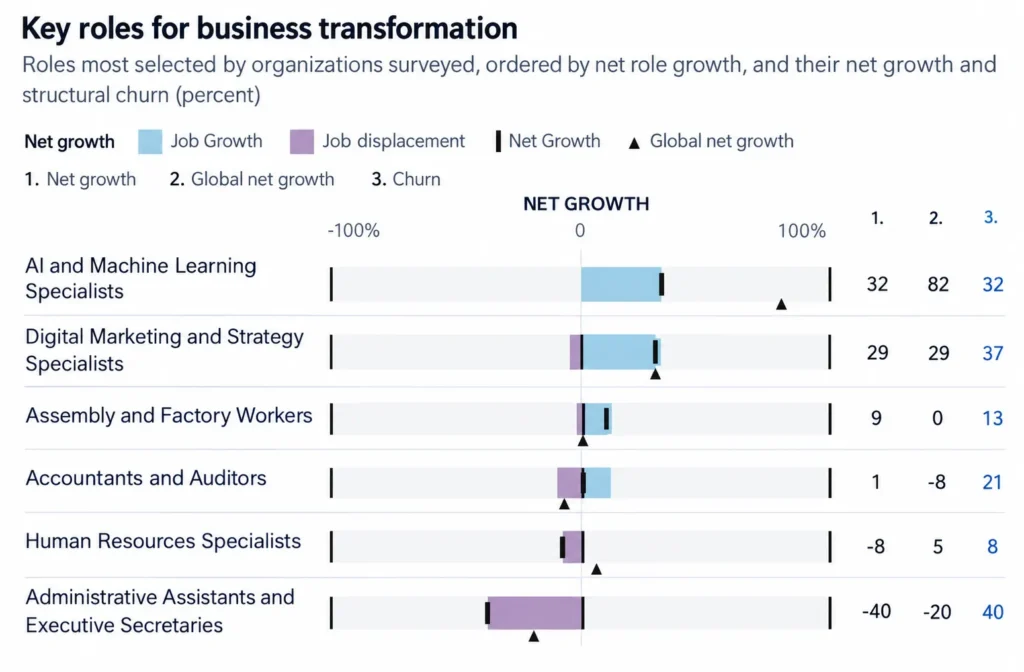
Its findings point to an important distinction: learning a particular tool isn’t the same as developing a durable professional skill.
Learning to operate Google Ads is useful. Understanding why a campaign isn’t profitable is more valuable.
Learning to generate content with ChatGPT is useful. Knowing whether that content answers a customer’s question and supports a business objective is more valuable.
So, should you worry about AI?
You should take it seriously, but you shouldn’t assume it will eliminate digital marketing as a career.
Some routine tasks will require fewer working hours. Certain entry-level responsibilities may be combined or automated. Employers may expect beginners to become productive more quickly.
At the same time, AI creates opportunities to test more ideas, analyze larger datasets, and manage increasingly complex marketing systems.
There’s no guarantee that every role will survive these changes.
For someone starting in 2027, the sensible approach is to learn digital marketing and AI together, rather than treating them as separate subjects. Consider joining an AI-powered digital marketing course, rather than outdated and traditional ones.
Read in detail about Will AI replace digital marketing jobs!
Which digital marketing careers have the best prospects in 2027?
Digital marketing isn’t a single job. An SEO specialist and a performance marketer may both work in digital marketing, but their daily responsibilities, tools, and skills can be quite different.
These are six career paths worth exploring.
| Career path | What you’ll do | Important skills |
| Performance Marketing | Manage paid campaigns to generate leads and sales | Google Ads, Meta Ads, tracking, CRO |
| SEO & GEO | Improve visibility across search engines and AI search experiences | SEO, technical audits, content strategy, AI-search visibility |
| Marketing Analytics | Measure campaign performance and customer behavior | GA4, GTM, Looker Studio, SQL |
| Content Strategy | Plan and improve content for business and audience needs | Research, SEO, editorial strategy |
| Marketing Automation | Build customer journeys and automated communication | CRM, email marketing, segmentation |
| Social Media Marketing | Grow brand presence and audience engagement | Content strategy, platform analytics, creative planning |
These aren’t ranked by salary or guaranteed job growth. They’re different specializations with opportunities and challenges.
1. Performance marketing
Performance marketers work on advertising campaigns where outcomes such as leads, purchases, or customer acquisition can be measured.
You’ll work with Google Ads, Meta Ads, landing pages, conversion tracking, and campaign reports.
For example, suppose an online education company spends ₹1,00,000 on advertising and generates 500 leads.
The cost per lead is ₹200.
But that alone doesn’t tell you whether the campaign was successful.
If only five leads become paying customers, the acquisition cost is ₹20,000 per customer.
A capable performance marketer needs to understand both numbers and determine whether the business can afford that acquisition cost.
This mix of advertising, analytics, and business reasoning makes performance marketing an interesting career for people who enjoy experimentation and working with numbers.
You learn all these skills in the performance marketing course by LPT Skills. You can book a free live class and ask anything during the session directly to your mentor.
2. SEO and GEO
Search engine optimization has traditionally focused on making websites more visible in Google and other search engines.
That remains important.
But search behavior is changing with AI Overviews, ChatGPT, Perplexity, and other AI-powered search experiences.
This has increased interest in Generative Engine Optimization (GEO), which focuses on improving how brands and content are discovered, represented, and cited in AI-generated answers.
A professional working in this area may need to understand technical SEO, content quality, structured data, information retrieval, brand signals, and measurement.
It’s an evolving specialization. GEO isn’t a completely separate replacement for SEO, and the industry hasn’t settled on one universal approach to measuring AI-search visibility.
Learning both traditional SEO and emerging AI-search practices may provide broader career options.
3. Marketing analytics
Every digital marketing channel generates data.
Someone needs to turn that data into useful decisions.
Marketing analysts work with website traffic, conversion events, attribution, campaign performance, and customer behavior.
They may use GA4, Google Tag Manager, Looker Studio, spreadsheets, and SQL.
This path may suit you if you enjoy working with data more than writing content or creating campaigns.
4. Content strategy
AI has made basic content production faster, but producing more content isn’t automatically a successful marketing strategy.
Someone still needs to decide what to publish, who it’s for, what makes it useful, and how to measure its performance.
Content strategists combine audience research, editorial planning, search intent, distribution, and performance analysis.
Writing remains useful, but understanding the purpose and quality of content is increasingly important.
5. Marketing automation
Marketing automation professionals work on workflows that help businesses communicate with prospects and existing customers.
For example, an e-commerce company might send different messages to first-time visitors, abandoned-cart customers, and repeat buyers.
Building these workflows requires an understanding of customer journeys, segmentation, CRM platforms, and conversion measurement.
6. Social media marketing
Social media marketing includes content strategy, community management, audience research, campaign analysis, and creative experimentation.
It’s much more than publishing posts or making reels.
A good social media marketer understands why certain content works, how it contributes to brand or business goals, and how to adapt to platform changes.
Which career should you choose?
If you enjoy numbers and experimentation, explore performance marketing or analytics.
If you enjoy research, websites, and problem-solving, consider SEO and GEO.
If you’re interested in storytelling, audiences, and communication, content strategy or social media may be a better fit.
You don’t need to make a permanent decision immediately. Learn the fundamentals, try a few small projects, and specialize based on what you enjoy and perform well at.
How much can you earn in digital marketing in India in 2027?
Salary is an important consideration, especially if you’re investing time and money in learning a new skill.
But digital marketing salaries vary significantly depending on your role, location, employer, experience, and ability to deliver results.
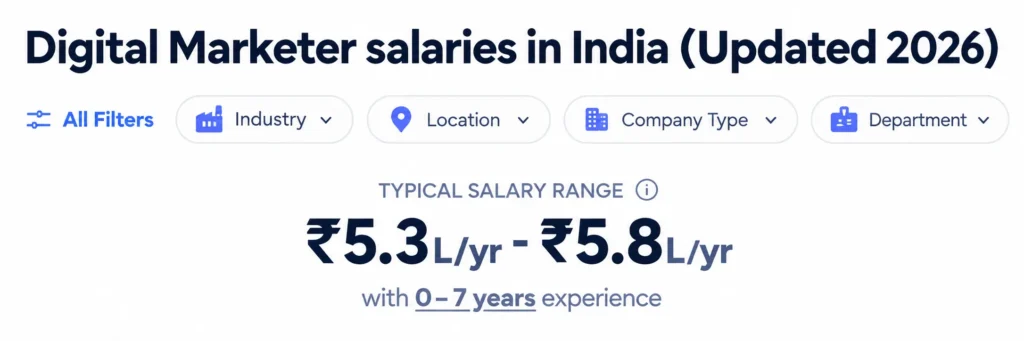
As of September 16, 2026, AmbitionBox reported an average digital marketing salary in the range of ₹5.3 lakhs per year to ₹5.8 lakhs per year.
What can help you earn more?
Experience matters, but the number of years on your resume isn’t everything.
Consider two people who have worked in performance marketing for three years.
One has mostly followed instructions and generated campaign reports.
The other has managed meaningful advertising budgets, fixed tracking issues, improved landing page conversion rates, and helped businesses acquire customers profitably.
They may have the same years of experience, but their demonstrated capabilities are different.
The second candidate can give employers stronger evidence of business impact.
That doesn’t guarantee a higher salary, but it can strengthen their case during hiring and salary negotiations.
A useful way to approach your career is to focus on building skills you can demonstrate, not simply collecting more certificates.
Advantages and disadvantages of a digital marketing career
Digital marketing has genuine advantages. It also has challenges that career-focused articles often ignore.
| Advantages | Disadvantages |
| Opportunities across multiple industries | Competition for beginner-level roles |
| Several specializations to explore | Tools and algorithms change frequently |
| Scope for freelancing and consulting | Campaigns often carry performance pressure |
| Many skills can be learned through practical projects | Routine work is increasingly affected by AI |
| Performance can often be measured | Requires ongoing learning and experimentation |
| Potential to move into leadership or entrepreneurship | Career growth and income aren’t guaranteed |
The difficult part isn’t always learning digital marketing
Many beginners can learn how to create a Meta Ads campaign or publish a WordPress blog within a relatively short period.
- What takes longer is understanding why something works.
- Why did the advertising cost increase?
- Why did a website lose rankings?
- Why are leads coming in but sales aren’t increasing?
- Why is one audience responding better than another?
These questions require investigation, experience, and judgment.
You’ll make mistakes while learning. Campaigns may fail. Strategies that worked six months earlier may stop delivering the same results.
If you enjoy testing ideas and learning from evidence, this can be interesting work.
If you expect to learn one set of tools and use them unchanged for the next ten years, digital marketing may be frustrating.
Is digital marketing the right career for you?
You don’t need to be a programmer, designer, or commerce graduate to start learning digital marketing.
People from arts, science, commerce, engineering, and other backgrounds can enter the field.
But qualifications alone don’t determine whether you’ll enjoy the work.
Digital marketing may be a good fit if you:
- Enjoy understanding why people make buying decisions.
- Like solving problems and testing different approaches.
- Are comfortable learning new technology.
- Can work with numbers, even if you’re not naturally strong at mathematics.
- Enjoy a combination of creative and analytical work.
- Are willing to keep developing your skills.
You may find it less suitable if you strongly dislike uncertainty, frequent changes, performance measurement, or regular experimentation.
Is digital marketing a good career after graduation?
For fresh graduates, one advantage is that many practical skills can be demonstrated through projects without needing a degree specifically in marketing.
For example, a graduate who can show a well-documented SEO audit, a working analytics dashboard, and a campaign case study has concrete work to discuss during an interview.
That doesn’t mean every employer will ignore academic qualifications. Some roles still have degree or experience requirements.
But building a practical portfolio gives you something more useful than simply saying you’ve completed a course.
Is digital marketing good for working professionals who want to switch careers?
It can also be a reasonable career transition, particularly if your previous experience connects with marketing.
Someone from sales may already understand lead quality, customer objections, and conversion.
Someone from journalism may have strong research, writing, and editorial skills.
Someone from finance may be comfortable with reporting, budgets, and performance analysis.
The challenge is translating those strengths into practical marketing capabilities.
You may need to start in a junior position, accept a temporary reduction in compensation, or build experience through projects before switching.
It’s worth evaluating that trade-off before resigning from your current job.
How to start a digital marketing career in 2027 (even without experience)
If you’re starting from zero, you don’t need to learn every marketing platform at once.
A better approach is to build a foundation, choose a specialization, and demonstrate that you can apply what you’ve learned.
Here’s a practical roadmap.
Step 1: Understand how digital marketing works
Start by learning how businesses attract and convert customers online.
Focus on concepts such as:
- Search engine optimization
- Paid search and social advertising
- Content marketing
- Landing pages and conversions
- Customer acquisition cost
- Marketing analytics
- Email and lifecycle marketing
Don’t try to master everything immediately.
Your goal is to understand how the different channels connect.
For example, a Google Ad might bring someone to a landing page. That visitor might fill out a form, become a lead, and eventually make a purchase.
Understanding that journey makes it easier to specialize later.
Step 2: Choose one skill to learn deeply
After understanding the fundamentals, select one area.
- If you choose performance marketing, start with Google Ads or Meta Ads.
- If you choose SEO, learn how search engines discover, understand, and rank pages.
- If you choose analytics, start with GA4, spreadsheets, and basic measurement concepts.
Give yourself enough time to work through real examples instead of switching to a new tool every few days.
Step 3: Learn how to use AI in your workflow
AI should be part of your learning process, but it shouldn’t replace understanding the subject.
Suppose you’re learning SEO.
You could use ChatGPT or Claude to organize keyword research, generate content outlines, write scripts, or analyze exported datasets.
But you still need to verify the output.
AI may misunderstand search intent, invent information, misinterpret data, or make recommendations that don’t fit the business.
Learning how to evaluate AI-generated work is just as important as learning how to prompt it.
Step 4: Work on practical projects
This is where many beginners struggle.
They complete tutorials and earn certificates, but have little work to show during interviews.
You can change that by building a few projects.
For example:
Project 1: Audit a local business website
Choose a publicly accessible business website and evaluate its SEO.
Look at page titles, heading structure, content quality, indexing signals, mobile usability, and basic technical issues.
Document the problems, explain their likely impact, and recommend fixes. Don’t claim improvements unless the changes were actually implemented and measured.
Project 2: Build a sample marketing analytics dashboard
Use a legitimate demo dataset or Google’s GA4 demo account.
Create a dashboard showing traffic sources, engagement, and conversions.
Write a short explanation of what the numbers suggest and what additional information you’d need before recommending changes.
Project 3: Create a small marketing campaign
With permission from a business and an agreed budget, create a campaign with a clear objective, audience, conversion event, and measurement plan.
Record what happened.
If you don’t have access to a real advertising budget, create a campaign plan and clearly label it as a simulation rather than claiming actual campaign results.
Step 5: Build a portfolio
A portfolio doesn’t need to be a complicated website.
You can start with a Notion page, Google Drive folder, or a simple personal website.
For each project, explain:
- What problem you were trying to solve.
- What information you analyzed.
- What actions you took or proposed.
- Which tools you used.
- What results you measured.
- What you learned.
If the project didn’t produce the expected result, explain why.
An honest case study that demonstrates your reasoning can be more credible than an impressive-looking but unsupported claim.
Step 6: Apply for internships and entry-level jobs
Look for opportunities where you’ll get meaningful hands-on experience.
For beginners, agencies can be useful because they often work with multiple industries and marketing channels.
In-house roles may provide deeper exposure to one company’s customers, products, and business objectives.
Neither is automatically better.
During interviews, ask what kind of projects you’ll handle, which tools you’ll use, who will review your work, and how your performance will be evaluated.
Avoid choosing a role solely because the company offers a certificate or internship title.
The quality of experience matters.
What will make a digital marketer valuable in 2027 and beyond?
Marketing platforms will continue changing. New AI tools will appear, existing products will add more automation, and some methods will become less effective.
Trying to learn every new tool immediately isn’t a sustainable career strategy.
Instead, focus on five capabilities that can remain useful across platforms.
1. Understanding business objectives
Know how marketing contributes to customer acquisition, sales, retention, and profitability.
2. Analytical thinking
Learn to question data, identify patterns, and distinguish useful metrics from numbers that merely look impressive.
3. AI literacy
Understand where AI saves time, where it makes mistakes, and how to integrate it responsibly into real workflows.
4. Creative problem-solving
Be willing to test different ideas when existing strategies stop working.
5. Specialized expertise
Develop enough depth in one area to solve problems that beginners or generic automation tools cannot handle reliably.
This combination gives you a stronger foundation than knowing the latest version of a particular marketing tool.
So, is digital marketing a good career choice in 2027?
Yes, digital marketing is a good career in 2027, especially if you’re willing to build practical skills and keep learning.
The growing investment in digital advertising suggests that online customer acquisition will remain important to businesses. AI is changing how that work gets done, but it hasn’t removed the need for marketing strategy, measurement, creativity, and business judgment.
That doesn’t mean digital marketing is an easy career or that completing a short course guarantees employment.
You’ll need practical experience, a portfolio, and the ability to demonstrate what you can do.
If you enjoy technology, creativity, problem-solving, and understanding how businesses grow, digital marketing is worth exploring.
If you’re looking for structured, hands-on training, LPT Skills offers digital marketing and specialized training programs with practical projects, internships, and placement support.
Start by learning the fundamentals. Work on something real. Then decide which part of digital marketing you want to get better at.
Frequently asked questions
Yes, digital marketing can be a promising career for fresh graduates. There are opportunities in SEO, paid advertising, content, social media, and analytics. However, entry-level positions can be competitive. Having practical projects, an internship, and a portfolio can help demonstrate your abilities to potential employers.
AI will automate some marketing tasks and change certain job responsibilities, but it isn’t accurate to predict that all digital marketers will be replaced. Professionals who understand strategy, customer behavior, measurement, and business outcomes will still have valuable skills. The extent of future job displacement remains uncertain.
Digital marketing offers opportunities across many industries, but no career is completely stable. Marketing budgets can change, companies can restructure, and technology can automate tasks. Developing transferable skills, gaining experience, and continuing to learn can help improve your career resilience.
Employers hire based on practical skills, project experience, and a portfolio, while others require a degree. You can begin learning digital marketing without a specialized marketing qualification. Whether you can secure a particular job depends on the employer’s requirements and your demonstrated abilities.
Performance marketing, SEO and GEO, marketing analytics, automation, and content strategy are all worth exploring. There isn’t one specialization that’s best for everyone. Your choice should depend on your interests, capabilities, local job opportunities, and the kind of work you want to do.
Yes. Commerce students may find marketing budgets, analytics, and customer acquisition familiar, while arts students may have useful strengths in communication, research, and creativity. Neither background guarantees success. Practical marketing knowledge and the ability to apply it are essential.
Yes. Professionals from sales, content, technology, finance, and other backgrounds can transition into digital marketing. Your existing experience may be useful, but you’ll still need to learn relevant tools and workflows. Consider the financial implications and entry-level requirements before making the switch.
You can develop a foundation in a few months through structured learning and regular practice. Becoming job-ready depends on your specialization, previous experience, and the quality of your projects. Developing advanced expertise generally takes much longer and requires practical work.
Digital marketing is likely to remain relevant as businesses continue using digital channels to reach customers. However, specific roles and skills will change, particularly as AI advances. A ten-year career is more likely to benefit from adaptability, specialization, analytical thinking, and ongoing learning than reliance on any single tool.